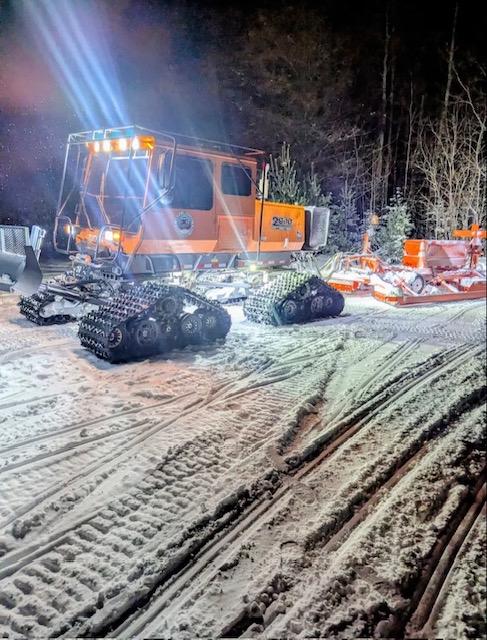
It’s 6:00 PM Friday night and Mark Franckowiak pulls into the Martin Rd parking lot at the head of the CJ Ramstad North Shore State trail. The North Shore of Lake Superior has been hit with a blizzard that started Tuesday night and finished up Thursday morning, dumping between one to three feet of snow over the trails and knocking down hundreds of trees. Since the storm, snowmobiles have already been flocking to the area and the Duluth Drift Toppers Snowmobile Club that Mark is a member of has been out cutting up trees on their trail system for two days. Mark is a heavy equipment operator by day and decided in 2019 that he needed to give back to the sport he loved so much and start doing his part to maintain the trails he enjoyed riding on for so many years. On Friday morning the Minnesota DNR had contacted Mark and told him that they wanted the club to do a groomer run that night. The Drift Toppers maintain the Duluth City East Trails and the Rice Lake Trail that are just a small part of the huge Grant-In-Aid trail system that makes up most of the 22,000 miles of trails in the state- but they are also contracted by the DNR to run the first 14 miles of the CJ Ramstad North Shore State Trail from the Martin Road Lot to the Reservoir Road where the Pequaywan Area Trail Blazers pick up the trail until Laine Rd., but the warm weather and lack of snow had suspended grooming operations for the last couple of weeks. This storm, however, had changed things dramatically. There was plenty of fresh snow but also a lack of a base or any packed trails, additionally there are huge snow drifts that would have to be contended with and scores of downed trees which would need to be removed. The club had been out Thursday and Friday clearing, packing and then grooming their club trails and the 2002 Tucker had already been getting a workout- but now the big task- the North Shore State Trail which runs north south and had been hit with the full force of the storm. Mark put out a note to the club who sent an E-mail out to the club members for a second groomer operator to go out on the trip and Josh Carlson answered the call.
Josh literally grew up in the Drift Toppers club- his dad, Mark, had been a member since the 1990s before there ever was a groomer shed and when the then 1990 Tucker groomer the club had at the time was parked across the street at his neighbors’ house. As a young boy Josh would watch out the window as his father climbed into the groomer and drove off and dreamed of the day that he could get into that big machine just like his dad. After years of hounding him, when Josh was 13, he finally convinced his dad to let him go on a grooming run with him and has been grooming the trails for 21 years since. The 1990 Tucker served the club faithfully for decades before the club raised enough money a few years ago to upgrade to a 2002.
When Mark found out that he was going to be riding with Josh he couldn’t be happier- not just because Josh has 21 years of experience but also because Josh is a giant bear of a guy that does the work of five normal human beings. Josh’s specialty is doing stuff that needs good old fashioned brute force and when it comes to moving trees he makes Paul Bunyan jealous. Likewise, Josh was thrilled that he was teaming up with Mark who knew more about the groomer mechanically than anyone else outside of Jeff BarBee the club’s head groomer mechanic who takes pride in volunteering his time to keep the 2002 Tucker in top operating condition.
Both men knew they had just volunteered for a long night, all of this after working their normal jobs all day, but they love what they do and even though grooming is a lot of work there is also the satisfaction of looking behind you and seeing that perfect flat white ribbon that you just laid out. They walk up to the Bob Klein maintenance shed where the groomer is stored. Bob passed away several years earlier but was an enormous part of the snowmobile community in Northeast Minnesota, having been the past club president and having been a part of MNUSA Region 7 for decades, he helped build a huge portion of the trails we all ride on today. The Drift Toppers Club is one of the oldest in the state and the very existence of sections of the North Shore State Trail can be traced back to the club’s founders. Bob was also the head mechanic on the old Tucker until his health prevented him from doing what he truly loved and when he passed, the club decided to name the maintenance shed in his honor.
Josh was sad to see the old Tucker go, having spent so many hours of his youth in it, but the volume of work that Tucker had to endure just became too much- at the peak of its use it ran the Duluth City East Trails on Wednesday Night, The Rice Lake Trail on Thursday night, the NSST on Friday and Saturday and the Rice Lake trail again on Sunday and then it spent Monday and Tuesday under the care of a group of mechanical surgeons making sure she would be ready to go again by Wednesday. Now the club has two groomers- the Tucker runs the City Trail and the North Shore Trail while the Rice Lake Trail duties are handled by a 2006 BR 180, that way the club can have their whole system done every weekend for all of the traffic that they get.
Mark and Josh get everything ready for the trip, they make sure the chainsaws are gassed up and ready to go and check to make sure all of the equipment is working the way it should. Once the Tucker is warmed up they head out onto the NSST. Mark will drive on the way up and Josh will take over on the way back, this will make Josh the primary tree mover on the way up- his specialty. As soon as they cross Martin Rd they face their first obstacle- a series of open fields. The North Shore Trail runs north and south and the 50 mile an hour winds have been blowing from east to west across the trail leaving behind snow drifts that are three to five feet high. Grooming is a science- you can’t just pull a drag behind you and call it good. Mark knows this but it is the first run after a major winter storm and they are going to try to set it up the best they can, for now the goal is to just get rid of the rolling drifts and at least get the trail flat. Mark lowers the blade on the Tucker in order to cut through the drifts and fill in the troughs between them but this will create another problem- soft snow between the hard snow compacted in the drifts that hasn’t been packed yet is susceptible to being dug out by the tracks of passing snowmobiles and over time that leads to mogul formation. To combat this, Mark uses a combination of the blade of the Tucker and skilled driving to try to compact the trough snow as much as possible- it is a skill he has developed over time both as an equipment operator and groomer, one that can only be learned by doing and trial and error – everything on the groomer is that way, from where to set the blade height on the drag to the speed you need to travel to get the perfect groom, it takes a lot of skill and knowledge of snow and the learning curve is pretty steep, but these guys know what they are doing. There is definitely a difference in groom quality between veterans and rookies and tonight the Drift Toppers have two of their best operators out there.
After pounding through the massive drifts, the first few miles of the trail go relatively smooth as volunteer club members had gone out earlier that day to get rid of some of the trees. The DNR had not been able to make it all the way down the trail to Duluth clearing the trail, so that task has now fallen on the shoulders of the club. After they get past the first few miles that the club members had cleared on their snowmobiles, they come to a virtual tree apocalypse- massive white pines and spruces that have fallen across the trail, partially buried in the snow. If the trees are laying across the trail, Mark can easily grab them with the blade and lift them up and push them off to the side, but if they are in line with the groomer they tend to ride up the blade and want to impale the two guys in the cab so Josh gets out and starts cutting. Mark jumps out and starts tossing branches off to the side while Josh moves the trunks. Progress is painfully slow- ten feet and there’s another monster, twenty feet, another monster then trees piled on top of each other- snowmobilers have gone around a lot of these trees but these guys have to make sure it is clear going the whole way. Josh is getting worn out so they start switching off- if the tree is more on the passenger side Josh gets out- more on the driver’s side and Mark gets out for the real big ones they both get out. The snow is knee to waist deep around these trees and they are getting soaked both in sweat and melting snow when they climb back in the cab. The deep snow under the trees create a new problem- there hasn’t been any snowmobiles running over that area to pack it down and now the groomer has to do the work, and if they aren’t careful with their pack, the drag can hit an area of deep unpacked snow and get stuck.
Eleven miles in they come to a bridge, they get half way across it and suddenly the groomer dies and they are left sitting on the bridge in the darkness. There is a smell of something burning. This is big trouble- they are completely blocking the bridge and there is no way around the groomer- if they can’t get it moving again, the NSST from here to Duluth will be instantly closed. The two men grab flashlights and start checking things out, Josh is at a complete loss, but Mark follows his nose and starts pulling off panels and sees that some ignition wires have frayed and shorted out and started a mini electrical fire that quickly went out. He moves some things around, tapes some things up and cranks over the ignition- the groomer fires back up and the two celebrate- but their joy quickly gets subdued as they realize they have lost their heater and a portion of their lights but the groomer is still running and functioning. There are three miles left to go until they turn around so they decide they will press on.
They keep going down the trail and run into a lone snowmobiler heading south. They stop and let the guy pass, he gives them a wave and a thumbs up and when he gets past the groomer he proceeds to the middle of the ribbon they just laid own and punches it, leaving a big trench in what they just got done grooming, Josh spits out a flurry of four letter words. “Some people just don’t get it,” replies Mark.
They grind their way forward and come across even more trees, they are both soaked from the snow but now when they climb back in the cab there is no heat and the outside temperature is only 12 degrees. What was once cold wet clothing now becomes cold ice covered clothing. They get to the turn around and switch drivers, now it is just a matter of getting back to Duluth yes it’s just 14 miles but at groomer speed and a fuel stop they’ve got over two hours left without any heat.
The trip back is uneventful, but by the time they roll into the shed at just past 1:00 AM both men are freezing. Mark is frozen to the core and can’t wait to get into his car for heat and then into a warm shower to bring his body temp back up. Josh is covered in icicles and looks like a giant frozen Yeti, over the years he’s had trips like this before and just wants to go home and get some sleep. Overall the 28 mile round trip took them almost 7 hours.
In the morning Mark returns to the shed and fixes the wiring problem on the groomer and at 6:00 PM Saturday night Mark and Josh climb back into the Tucker for another grooming run. The night will go much smoother with the trails well used and packed down during the day and the Saturday night run only takes three and a half hours. On Sunday morning trailers arriving in the Martin Road Parking Lot are treated to a pristine 14 miles of trail courtesy of The Drift Toppers Snowmobile Club and their volunteers.
SNOWMOBILING: A SPORT ON LIFE SUPPORT
What a difference a couple of years make. Turn back the clock to the winter of 2020-2021, the post Covid effect is in full swing: People have been driven out of their homes into the outdoors, family recreation is more popular than ever, interest rates are down, stimulus money has been pumped into the system and there is snow on the ground. In a rush to get outdoors people flock to the power sports dealers and buy every snowmobile they can. Soon the glut of back inventory is gone and attention turns to the used market- every 1990’s era snowmobile that turns over and has spark is drug out of the barn and resurrected and either put into use or sold as if it were made of gold- prices for used snowmobiles hit insane levels. Boots, gloves, jackets, snow pants and helmets disappear from store shelves, by spring of 2021 hordes of new and old snowmobilers decide it is time to buy a new snowmobile- spring orders go insane for the MY 2022 sleds- the industry has been reborn. But then the supply chain issues hit and those MY 2022 sleds don’t get delivered until March or April of 2022, orders get cancelled and what could have been one of the biggest sales years ever is handcuffed by the failing supply chain resulting in the inability of the manufacturers to make new snowmobiles- some riders become disillusioned- but hope is not lost- people still order MY 2023 sleds fearing that it may take until spring of 2023 to get them- supply chains improve- sleds get delivered on time and to top it all off the winter of 2022-2023 is a snowmobiler’s dream with tons of snow everywhere and the industry is riding high.
Then it happens- the snowball is pushed off the top of the hill and starts to roll. Rising demand inflates prices to the point that people start rethinking the wisdom of purchasing a new sled. A top of the line sled now costs $20,000+ and an entry level snowmobile that used to cost $8,000 just a few years earlier now costs you $12,000 and all that gets you is a boring 550 fan, a gallon of oil now costs $100, helmets creep up to $500, gloves cost you $200. Inflation in the real world rears its head and prices of everything skyrocket, what used to be a $20 bill at the grocery store is now $40. Interest rates to take out a loan on anything are insane.
Yamaha decides to get out of the game and then Mother Nature deals its death blow: a winter of no snow- anywhere- even the mountains don’t get their usual snowfall and nearly all of North America has a snowless winter. On top of that, many of the snowmobiles that had been bought over the past few years are plagued with recalls. Showrooms are full of unbought sleds and unpurchased gear. And the issues don’t just end there- it falls to the entire recreational vehicle industry- not only are people not buying snowmobiles they aren’t buying boats or watercraft or side by sides- and a $40,000 price tag on a side by side doesn’t help- now you are paying more for power sports vehicles than you are paying for cars- not to mention all of the additional gear you need and the trailer to pull them around.
So here we sit- going from an unprecedented resurgence in the sport just a few short years ago to being on the brink of death. The stock prices of BRP and Polaris have plummeted, Yamaha is gone, Arctic Cat is pausing production and there are overpriced sleds and ATV’s collecting dust on showroom floors. Even if prices were reasonable no one can afford the interest on a loan. The problem has spread from the manufacturers to the very fabric of snowmobiling itself- the trail system. Registrations in Minnesota are down by 60% and the story across the country is similar. Why spend money to register a snowmobile when you might not get snow, especially when you are struggling to put food on the table? That mentality has put the states in a big hole. The funds to groom which are fed by registrations aren’t there so if it does snow we could be in for some big problems late in the season. There is another issue- the average age of snowmobilers keeps going up and unfortunately the base is literally starting to die off and the younger generation has no money to spend on recreational vehicles when housing and interest rates burn up so much of their cash. Asking one of these millennials to buy a $20,000 sled is the equivalent of asking them to do brain surgery without any training or medical instruments.
Is there any relief in sight? One thing that came out of the Covid era is the realization by many people that those 90’s era sleds although not as advanced or comfortable as the modern sled is still pretty darn fun, easy to work on and doesn’t cost them their first born child to put out on the trail and because so many of them were resurrected during Covid there are plenty of them around in the used market for 5-10% of what a new sled costs you. At that rate you could buy ten 1990’s era sleds and ride them until they blow up for the cost of one new top of the line snowmobile. It is hard for the industry to compete with that- especially if it only snows for two months.
So is there any hope? Yes there is. It is often said in sports that winning cures everything and it does. For snowmobiling SNOW cures everything, and that is literally what it will take to breathe life back into the sport. The 1990’s boom started off with one thing- early snowfall in 1991 and it kept coming for a half dozen years. The same thing could happen again. Long winters means people riding- If you get early snow and winters are long even the casual snowmobiler gets the urge to get out on the trail- that starts piling up miles. More miles means more wear and eventually those old sleds do get used up- it has been happening since the 1960s. Those 1990’s and early 2000’s sleds become vintage sleds and become snowmobiles that only get ridden on vintage weekends. The market also forces the manufacturer’s hand- adapt or die. There will be a demand for a simpler less expensive sled- we aren’t talking a 550 fan or underpowered 600 either- build a regular 600 with a basic setup for an affordable price and you will own the market. All the bells and whistles are nice but the average rider doesn’t need them. They want a dependable engine with good power and that is what a full blown 600 gives you. Combine that with your standard no frills front suspension and rear skid that used to be high end ten years ago and you are golden. The reason the Indy 500 dominated the 90’s is because it did just that- enough dependable power for the average rider and enough good suspension for the average rider- I you wanted to upgrade to something fire breathing and crazy with a sweet XC suspension you could get it but for the average snowmobiler the Indy 500 gave them everything they wanted. The 550 or little 600 is fine for teens or occasional riders but the everyday guy wants an inexpensive 600 that gets the job done, give them a base 600 and you win the market, then offer all the exotic crap for the old guy with money falling out of his pockets or the young guy that needs to impress his friends. The reason Ford dominated the world with the model T is because he wanted a car the average person could afford. It’s time for one of the manufacturers to wake up, whoever does it first wins. But regardless of the economy, interest rates or the manufacturers, the one key ingredient we need is…SNOW! LET’S GET SOME!!!
>
NORTHEAST MINNESOTA SNOWMOBILE TRAIL CONDITIONS 2/20/23


2/10/23 NORTHEAST MINNESOTA SNOWMOBILE TRAIL CONDITIONS UPDATE
The warmer weather softened things up a bit but the clubs were able to lay down some nice tracks earlier in the week and with colder weather last night and into tonight it is shaping up to be another excellent weekend. Traffic should be heavy as the migration from the melting trails in the southern part of the state begins so stay right and stay safe. The ALS Blizzard tour is also out there this weekend so there will be lots of sleds to contend with especially between Grand Rapids and Duluth.TODAY ON THE TRAIL 12/31/22
As we were out saying goodbye to 2022 we were fortunate enough to meet the Hamlins- Isaac, Miranda, Adeline and Everett. There’s nothing more fun than riding with your family and passing the torch to the next generation of snowmobilers!!! Now for a quick trail update as this was the first day we got out to ride extensively: As stated before the trails are cleared enough to get the groomer through. The number of overhanging branches and downed trees on the sides of the trail is astounding. It will probably take all season to brush everything properly. PLEASE HELP YOUR LOCAL CLUBS!!!! There is a fantastic base but there are also wet areas and if you get off the side of the trail good luck to you- the snow is DEEP!!!! There are new branches and trees still coming into play so ride very carefully and help move or cut what you can.
WHAT’S NEW FOR 2022?
Hello everyone and welcome to another year of snowmobiletrail.com! It’s September and every year in the world of snowmobilers September marks a turning point. The leaves start changing colors, the nights start getting colder, snowmobile clubs have their first meetings, trail work begins in earnest and in the high elevations of the mountains a few snowflakes start making their way to the ground. Little by little that snow spreads and before you know it our favorite season is here! To me September lights a little spark and at snowmobiletrail.com we start writing stories for you to digest and get you more and more amped up for winter until you are chomping at the bit waiting for that first big storm. So what is on tap for 2022 at snowmobiletrail.com?
First off, last year we launched the snowmobiletrail.com YouTube channel which honestly took off with a resounding thud. We initially started with trail reports but soon found out that our print versions reached a much wider audience so we scrapped the video version and went back to print. Our goal, after all, is to get you the best information as quickly and conveniently for you as possible, but that doesn’t mean that the YouTube channel is dead. New for this year we will be breaking down local trails on the YouTube channel with our “Trail Ride” videos, where we ride a trail and give you some of the highlights of what you will see, that way you can find some real hidden gems off the beaten path. We know that a lot of people come up from southern Minnesota as well as from Michigan, Wisconsin, the Dakotas and other states and most of those people stick to the well-known arteries of the CJ Ramstad North Shore Trail and miss out on some truly unique and spectacular riding areas and trails and we will highlight these places in our videos. We will also be doing more “Today on the Trail” features with pictures and some videos of people we meet out on the trail. This has always been a popular feature and we are going to bring it back in a big way this winter. And of course we are going to have our up to the minute trail condition updates to help you plan your trips as well as some outstanding articles on the sport in general that we are sure you will find entertaining, informative and ramp up your heartbeat in anticipation of winter. As always we are hoping that this will be THE YEAR of tons of snow and great riding for the whole season. Start your snow dances and get ready for another great year, we will see you soon!
RIDE RECAP: 2022 YETI TOUR
The Yeti Tour is a charity ride that raises money for the Northland Newborn Foundation, an organization set up to help babies and families who experience difficulties in the first few weeks of life. The Yeti Tour has been helping newborns and their families since the ride was started in 2011 by Nate and Kelly Alvar of Duluth. Snowmobiletrail.com has been a supporter of the Yeti Tour since its inception and I have ridden in this event every year. My Yeti Tour 2022 experience actually started the night before the Yeti Tour. After years of horrible weather and trail conditions for the ride, this year was set up to be perfect. The weather was set to be in the 20’s and the trails were in the best condition they have been in in two years, and we had an abundance of fresh snow on the ground. I was so excited that I laid awake most of the night. I got out of bed a half hour before my alarm was set to go off and thought “I have hardly gotten any sleep. This is way too early to get up. I’ll just go back to sleep for another half hour…” We’ve all done it and you already know how that works out. So, an hour later I am sleeping through my alarm and my wife is punching me in the back trying to wake me up. I finally pop out of bed and scramble to get myself together. Registration for the Yeti Tour started at 8:00 with the ride commencing at 9:00. By the time I was ready to go it was 8:30 and I still had a 45-minute ride ahead of me just to get the staging area at the Island Lake Inn. As I was about to fire up my sled my buddy Allen texted me and told me he just got to the lot by the Island Lake Inn where the ride starts and apologized for being late, thinking that I was already there. I texted him that I was just leaving and hopped on my sled to get up to the Island Lake Inn. I was greeted by a perfectly groomed Rice Lake Trail courtesy of the Duluth Drift Toppers snowmobile Club, onto another perfectly groomed Hermantown Trail courtesy of the Hermantown Night Riders, up to Fish and Island Lake and a beautiful trail laid down by the Reservoir Riders Snowmobile club. We had so much snow and it has been so windy that I lost track of the trail markers going across Island Lake and relied on just my sense of awareness of where I was to find the Island Lake Inn, I only wound up about a half mile off course, but I got there by 9:15.
I was worried that everyone had already left, but as it turns out there were 60 riders registered and it took a while for everyone to check in plus several riders decided to take advantage of a tasty Island Lake Inn breakfast. We watched a couple of groups head out and I left with the main group that included Yeti Tour Founder Nate Alvar and several other members of the Alvar Clan along with friends and relatives. We rode out across Island Lake to the Reservoir Lakes trail which was also a beautiful part of the Reservoir Riders trail system (side note: the Reservoir Riders trail system is worth a trip up to Duluth, there’s lots of great terrain changes and lots of options for food, lodging and fuel in the area. See the snowmobietrail.com Northeast Minnesota Blog February 2016 Archives for an in-depth analysis of the Reservoir Riders Trail System). On the way our group started to split apart with Myself, Allen and Jake Alvar getting ahead of the pack; that is until I went into a turn and slid off the trail. I honestly have no idea what happened, one second, I’m on the trail
and the next second I’m off the edge buried in waist deep snow and I mean absolutely buried. Luckily the rest of the group caught up to us, and an army of guys helped dig me out. I can’t thank them enough; I would have been digging most of the day trying to get out of there without them. We stayed with the big group until the Normana pit where the three of us split off again on the beautifully, and I do mean beautifully groomed CJ Ramstad North Shore State Trail courtesy of the Drift Toppers Snowmobile Club. From there we turned onto the Pequaywan Trail which, as is usually the case, was perfect, courtesy of the Pequaywan Area Trail Blazers. I stayed at the back of the pack behind Jake and was able to witness him slide off the edge of the trail in a corner and puff down in a big deep trench of snow. This made me feel pretty good because now I wasn’t the only one who had gotten stuck. I helped Jake dig himself out. By this time and having dug out two sleds from over three feet of snow I was bushed. We beat everyone to the Pequaywan Inn except for two early groups that had gone on ahead to Hugo’s. We sat down for a Bacon Cheeseburger and beer fries and soon about 50 riders flooded into the Pequaywan Inn for lunch.
We ate and got ahead of the pack, heading out to the Brimson trail to ride to Hugo’s to refuel. The ride to Hugo’s was uneventful but the temperature in the 20’s and all of the recent snow had brought snowmobilers from all over the area out of the woodwork. Aside from the 60 Yeti sleds there were an additional 36 sleds we passed going the opposite direction with a great many more in Hugo’s parking lot. After we left Hugo’s, it seemed that there were more snowmobiles around every corner and the heavy traffic had taken its toll on the trail and it had started to develop some big body busting moguls. I was also seeing a number of areas where riders had slid off of the trail into the deep powder on the edge. There was a large group assisting one of these sleds that had slid off a turn and had dived deep into the woods. There were about five or six guys working on getting them out and a rider before and after the corner slowing sleds down to make sure none of these good Samaritans got hit. After passing this group of sleds there was another large group coming toward us on the straightaway, so we decided to pull off to the side to avoid riding through the bottleneck. As we pulled off Jake puled just a few inches off of the packed surface of the trail
and down he went into the waist deep powder. After laughing heartily in my helmet and feeling much less like a complete idiot for riding off of the trail earlier I was once again left with the task of helping Jake dig out, but this time Allen was there to help and came up with a much better plan of using manpower to literally lift the back of the sled onto the hardpack and use its motor in reverse to drag the front of the sled out as we assisted. It worked perfectly and we were on our way. The temperature had crept up to 28 degrees and now that combined with the punishing moguls and the workout, we endured pulling Jake out started to really amp up our riding temperature. We stopped to open up our jacket vents and get a little more air flow going to cool us down. Finally, we got to the Yukon Trail which had been again wonderfully groomed by the Voyageur Snowmobile club out of Two Harbors. We rode up to the John A Brandt Memorial Shelter to hang out with about 40 other riders who were enjoying this crown jewel of the Yukon Trail.
We left the shelter at about 1:30 and made the fifty-mile trek on the Yukon and North Shore Trail back to Duluth on absolutely fantastic trails that were holding up well in spite of the heavy traffic. Later that night I drove out to the after party at the Island Lake Inn where we gave away a new Honda four-wheeler courtesy of RJ Sport and Cycle in Duluth and Yeti Tour 2022 came to a close raising a healthy sum of cash for the Northland Newborn Foundation.
THE REVIVAL OF 1990′S ERA SLEDS
Human beings are strange. For the past several decades health officials have been trying to get people off of their couches and into the outdoors and it seemed as though they were fighting a losing battle. The leaders of the snowmobile industry were lamenting the steady decline in snowmobile sales worldwide and the future of the sport was in question, then came 2020, and more specifically the Covid 19 pandemic. Suddenly, we as human beings were told we had to social distance and shelter in place and that the best thing you could do was sit on your couch and watch TV, so what did we do? Exactly the opposite. Now that you were forced to stay home all people wanted to do was get outside, recreational vehicle sales went through the roof and one of the biggest benefactors in this resurgence was the snowmobile industry. People suddenly realized what a lot of us knew all along: snowmobiling is fun and a great way to get out of the house and spend time with your family. Dealers went from having excess inventory to trying to find new or used sleds wherever they could. Prices went through the roof and supply went to absolute zero. In spite of the lack of new sleds people still wanted to ride and families across the country went out to their barns and backyards to see if that old Indy 500 they parked fifteen years ago could still run. Dealers were suddenly overwhelmed with older sleds being brought in for rehab and soon parts for older models became scarce and registrations of older sleds went through the roof. Overnight the trails were full of old iron and families out enjoying winter.
Enter 2021. As supply chains slowly start to recover and other types of recreational vehicles are starting to become available the one industry that is still suffering from massive shortages is the snowmobile industry. Not only did Covid get mom and dad and the kids back out on the trail, it also got them to ride one of their buddy’s newer sleds and made them decide they want one of their own. The huge surge in preorders and continued supply chain pressure has put the delivery of some new sleds out almost a year from when they were ordered in April of 2021. With the urge to ride not being filed by the lack of new machines, more the 90’s and early 2000’s era sleds have been showing up on sales sights around the county for prices that a year or two ago were considered outrageous. Sleds that were going for a grand just 3 years ago are going for twice that and if you happen to have a nice sled that has been babied and kept in a nice heated garage its whole life with regular maintenance records and low miles you can charge blood and get it.
BUYER BEWARE
With all of these old sleds brought back to life, there are a number of people out there that have taken this opportunity to unload their problems on someone else. You hear more and more horror stories of the old “It ran great when I parked it” (ten years ago) or “It just needs the carbs gone through” (aka complete rebuild). Rusted suspensions, dead shocks, blown engines, bent frames, the list goes on and on. If you haven’t been around sleds a while the best thing you can do is take someone with you who can go over that machine with a fine toothed comb. Tips for buying a used sled can be found in our Northeast Minnesota Snowmobile Blog Archives from October of 2014-
THE DEAD SLED MARKET
With demand so high there has been another new market that has emerged: Dead sleds. Just like old cars in a farmer’s field, people have gone on the hunt for sleds that have good bones but are no longer in running condition. If you are handy with a wrench you can buy something for just a few hundred bucks and get it back on the trail. But this too has put pressure on parts houses and nearly wiped out the used snowmobile parts market of all of its inventory. Now even dead non-running snowmobiles are getting increasingly hard to find. I recently spoke to a guy who just bought a 22 year old sled with a blown motor who said, “Everything else is there and in good shape and I’d be paying $2,000 for this thing if it was running. For a few hundred bucks I can get this thing back on the trail.”
THE FUTURE IMPACT OF THE 90’S RESURGENCE
So what will be the fallout of the 1990’s sled revival? We are already seeing new sled demand increasing as well as a huge demand increase for snowmobile gear but what other effects will this have on the sport? Most of the side effects seem to be positive: Registrations of old and new sleds have increased dramatically leading to more money in state trail accounts. Snowmobile club memberships are on the rise and huge numbers of kids are taking part in snowmobile safety classes. All of this paints a bright future for the sport but of course there are going to be some negative impacts as well- rising new sled prices as well as rising prices on parts and gear. Also, in a few years some of these people that ponied up big bucks for a 90’s era sled will find themselves sitting on something worth 20% of what they paid for it. But for now those of us that have a love affair with the classic sleds will get to see more of them on the trail and at the local watering hole and we will also get to see the next generation of snowmobilers out enjoying the sport and helping keep it alive for decades to come.
NORTHEAST MINNESOTA SNOWMOBILE TRAIL CONDITIONS UPDATE 1/21/22
A little bit of snow and a little bit of cold weather has the entire Northeast Minnesota snowmobile trail system in really nice shape. Most of the wet areas have finally firmed up and ice thickness is improving on the lakes and ponds. The North Shore of Lake Superior has been hit especially hard with various amounts of Lake Effect snow over the past week, putting snow depth over 2 feet along half of the trail system and allowing the groomers to lay down a very nice trail. We are also supposed to pick up a few inches of fresh snow Friday Night so the trails will be really fun Saturday morning. It is supposed to be really cold for the weekend so dress warm. Also as the John Beargrease sled dog marathon approaches riders are encouraged to slow down and keep an eye out for dog teams out training, especially on the CJ Ramstad North Shore State Trail. Please remember that the our sport has its roots in the desire of inventors to create a motorized dog sled, in fact the first Ski-Doo was originally supposed to be called the “Ski-Dog” and was billed in their sales literature as “The Motorized Dog Team,” the prevailing theory is that they were having a hard time making the “g” look right on the V shaped logo and the artist just decided to change the “g” to another “o” and the Ski-Doo was born. In any case let’s be aware of our furry friends out there, we don’t want a repeat of what happened in Wisconsin a few weeks ago. Ride Safe, Ride Right, Keep Warm and we will see you out on the trail!
RIDE RECAP: YETI TOUR 2021
As Yeti Tour 2022 approaches on February 26th, I thought it would be a good time to reflect back on Yeti Tour 2021. I never really addressed it last year as the Yeti Tour wound up marking an abrupt and unhappy end to the 2021 Snowmobile season. Like most events, Yeti Tour 2021 had to make some adjustments due to Covid. The first change came with the structure of the fundraiser itself. With supply chain issues and demand going through the roof, the Yeti Tour was unable to secure its annual raffle prize so the primary funding structure reverted back to the riders taking donations to raise money for the Northland Newborn Foundation. Additionally the Yeti Tour’s normal base of operations for the beginning and end of the ride, the Island Lake Inn, was only open for limited seating so the big after party was cancelled and registration and ride set up had to be very structured and controlled to maintain Covid protocols. The one thing that the Yeti Tour was able to do, unlike so many other annual charity events, was to hold the ride portion of the event since it is a self-contained one day ride.
The biggest challenge for any snowmobile event is always the weather and the Yeti Tour has traditionally been a victim of horrible weather conditions regardless of the date: two years of no snow, multiple years of limited snow, extreme warm temperatures, extreme sub Zero temperatures, rain, the list goes on and on to the point that the running joke is it doesn’t matter what day you pick to hold the ride, whatever day it is the weather will not cooperate, and 2021 followed that infamous Yeti Tour tradition. Sporadic light snowfall had plagued the season and after a week of above freezing daily temperatures and bright sunshine I had no idea what kind of trail conditions I was in for. I left my house in plenty of time to ride up to Island lake and was greeted with my first problem, the ditch banging access trail I use to get to the state trail was completely melted, leaving me nothing but frozen dirt to ride on the road shoulder. Once I got to the trail I was relieved to see that there was a lot of snow still on the trail but my sled was already running hot due to lack of snow in the ditch. The week’s warm weather and overnight cold had made the trail as hard as a rock and prevented any snow from getting to my heat exchangers. I immediately thought of the ice scratchers I had on the wall of my garage that I had procrastinated installing all season and now I was paying for it. Finally I got to the Hermantown trail and unfortunately the section of trail I needed to take to Fish Lake runs North and South and there were huge patches of bare spots which jacked the heat up on my sled even more. I was finally forced to pull off the trail and let the sled cool down packing my heat exchanger with whatever snow I could find. Finally I reached the Lake and the sled had some relief until I got to the Between the Lakes Trail which was also almost compete dirt. Again the temperature rose on my sled until I reached Island Lake and was able to get some snow back onto the exchangers.
I finally arrived at the Island Lake Inn and registered at the registration booth they had set up outside. Already the morning sun was starting to heat things up and I debated just going home, but I know that the trails I had just taken were a no go so I decided to go on the ride anyway. I hooked up with my buddy Allen and we departed on the first leg of the ride which took us to the Pequaywan Inn. The trail suffered from some bare spots but t had also gotten warm enough for the hard frozen trail to become a little bit mushy and throw some snow on the exchangers. We were still running hot but not to the point that overheating was eminent. Once we arrived at the Pequaywan Inn Allen’s sled was running really hot and we mutually decided that it was best to just turn around and go home, so we did. Unfortunately we found out that the rest of the Yeti route had been blessed with a lot of snow and barely suffered any major snow melt, and the riders that stuck it out had a great time.
Allen peeled off to go back to Island Lake and I decided to take the North Shore trail back south to my house where I found large sections of the trail melted off. I was able to make it home and just like that the season was over.
So far this season we have been blessed with more snow and cold and are almost to the point that the groomers will be able to make a trail that will last the whole season barring any extreme heat and rain. This year the Yeti Tour is scheduled for February 26th. The Yeti tour is a great event and is a fun family friendly ride. You can register and find out more information by visiting www.yetitour.com.


